CMST 280 Intercultural
Communication (FORMERLY SPCH 230)
Winter 2013 Course Syllabus
Items: 0889 section OAS, 0890 section OBS, and 0891 section OCS
Office Hours:
My office is in R230V. Kindly email me to set up an appointment.
My Winter Quarter office hours are Tuesdays
and Thursdays from 10:30-11:20 AM
and by appointment.
Course Website:
go to http://bc.instructure.com then
log into Canvas. Your Username and Password are the same as you created
for your BC Network account.
Note: If you are using a PC, FireFox
or Google Chrome are compatible browsers with Canvas. If you are using a
Mac, Safari is compatible. Unfortunately, Internet Explorer is NOT
supported by Canvas.
Also note that the app version of Canvas for portable devices is
not fully functional at this time.
This is an online class. Computer use is required in order
to succeed in this course.
Instructor:
Stephanie Hurst
Email: Use ‘Conversations’ by
clicking on 'Inbox' on the upper right side of the screen on the Canvas
course website.
Office Hours:
My office is in R230V. Kindly email me to set up an appointment. My
Winter Quarter office hours are Tuesdays and Thursdays from 10:30-11:20 AM and
by appointment.
Important Recommendation: Students
are strongly encouraged to complete ENGL 101 before taking this course as a
college reading level in English as well as a college writing level in English
are needed to succeed in this class.
Required Text:
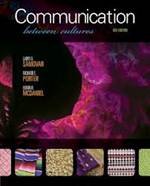
'Communication Between Cultures' by Larry A. Samovar, Richard E.
Porter, Edwin R. McDaniel & Roy, 8th edition. Note:
It is important to use the 8th edition as it differs greatly from
previous editions.
I have placed a copy of the course textbook on reserve in the
Bellevue College Library Media Center. This reserved copy may be used in the
library for 2 hour increments.
The text is available for purchase or rental at the Bellevue
College campus bookstore ($134.00 to purchase or $54.94 to rent). eTextbook options are also available at http://www.cengagebrain.com:80/shop/ISBN/9781111349103?cid=APL1#viewChaptersModalContentFocus
Optional Purchase: We will
also be reading the 7th chapter only of ‘Outliers: The
Story of Success’ by Malcolm Gladwell. I have
placed two copies of this book on reserve in the Bellevue College Library Media
Center. These reserved copies may be used in the library for 2 hour increments.
Course Outcomes…After completing this class,
students should be able to:
•
Explain how environmental factors affect and make cultures
different.
•
Explain how cultural variables influence intercultural
competency in communication.
•
Explain why appropriateness and effectiveness are critical in
constructing messages in intercultural contexts.
•
Explain how individualism and collectivism affect the
communication in intercultural communication contexts.
•
Apply various models of cultural values to intercultural
interactions.
•
Define ethnocentrism and social comparison.
•
Demonstrate your competence in applying the concepts across
cultures.
•
Identify and analyze one’s own cultural identity.
How to succeed in this class…Success in this class is
dependent on:
1. your motivation and desire to explore and learn,
2. your competence using Canvas,
3. logging into the course website and checking the
'Assignments', ‘Announcements’, ‘Calendar’ and email tools at least
five times per week,
4. keeping up with the assigned readings by the due dates,
5. your ability to read and write in English at the college
level,
6. the ability to learn from written materials, including
lectures, e-mails, and on-line discussions,
7. meeting the attendance policy and contributing in a relevant
and constructive manner to class discussions,
8. the ability to successfully collaborate and cooperative with
your colleagues,
9. a good working knowledge of your computer and your Internet
Service Provider (ISP), including e-mail,
10. self-discipline to focus, set goals, and complete
assignments on time without face-to-face contact with an instructor.
Computer Issues…
Should you experience any technical
computer issues (software or otherwise) anytime throughout the quarter, you
should contact the BC help desk at 425.564.HELP or submit a Request Center
ticket at http://depts.bellevuecollege.edu/ir/submit-a-ticket/ . You can also contact Distance Education:
425.564.2438 or toll free 1.877.641.2712, www.bellevuecollege.edu/distance,
Room A140, disted@bellevuecollege.edu.
If you are new to using Canvas or have
never taken an online (or hybrid) class before, I strongly encourage you to go
to http://bellevuecollege.edu/distance/Canvas_classroom.asp and review the online tutorial for Canvas.
You should also watch the Canvas Student Orientations well as review
steps for logging in to Canvas at http://depts.bellevuecollege.edu/ir/students/studentguide/class-sites/ You can also visit the Distance
Education Office in A140.
Required Assignments & Grades:
•
14 Online Discussion Responses &
Comments to Colleagues (each is out of a possible 40 points) worth
560 Points,
•
Cultural Identity Analysis Journal (10
– ? pages) worth 140 Points,
•
3 Quizzes (each out of 100 points) worth
300 Points
Total Points Possible from Required Assignments: 1000
*An additional 15 Extra Credit Points are possible the first
week of the quarter.
Grading Scale: A = 940 – 1000, A - = 900 - 939, B+ =
860 – 899, B = 830 – 859, B - = 800 – 829,
C+ = 760 – 799, C = 730
– 759, C - = 700 – 729, D+ = 660 – 699, D = 600 – 659, F = 0 – 599
Assignment Descriptions (Condensed)…
Specific guidelines and details regarding all assignments can be found on the
Canvas course website.
Online Discussion Responses & Comments to Colleagues (560
Points): Students will be evaluated on the quality and substance
of their contributions to 14 online discussions. Students are expected to
complete all required reading assignments by the designated due date and share
in a relevant, constructive and meaningful manner with their colleagues via
online discussions. (See ‘What Constitutes a Good Online Response’ on the
course website). Please do not attach a file to the discussion board
containing your post.
Each online discussion response will be
evaluated based on the following requirements:
1. Completeness: Each online discussion response
has two parts; a.) your initial response and, b.) your comments
to two of your colleagues’ responses. First, your initial response
should be fully developed addressing the question with adequate examples
from your life experience and thoughtful explanation of why or how. (A complete
initial response is typically a minimum of 200 words in
length). Next, after you complete your initial response to an online
question, you should read through several of your colleagues’ responses and
choose at least two to provide a comment to. Often a student will choose to
comment on a response that was most helpful to him/her in understanding the
course material better or one that he/she found interesting or
intriguing. Any comment to a colleague should adequately explain why
you found your colleague’s response helpful, interesting or intriguing. (A
complete comment to a colleague is typically 100 words in length.)
2. Appropriate Integration of Course Terms: your initial
response should appropriately integrate course terminology and
concepts from the assigned reading.
3. Format: course terms (key terms from the chapter
reading) used in your initial response should be typed in bold, or in all CAPITAL
letters so that they stand out on the screen. In addition, course terms
should have page references to the course textbook.
4. College Level Writing: organization, grammar and
spelling count for both your initial response and comments to colleagues.
Keep in mind that a student's initial response to an online
discussion question as well as their comments to colleagues will be evaluated.
Quizzes (3 @ 100 Points each): There will be 3
quizzes. Each quiz is worth 100 points and will consist of true/false and
multiple-choice questions. Quiz material will pertain to information
covered in the text, as well as, information discussed and presented in class
discussions and assignments. Review sheets will be provide for each quiz.
Review sheets can be accessed through the learning modules on the website. The
Syllabus Quiz is designed to help you become acquainted with the website and
worth 10 points.
Cultural Identity Analysis Journal(140 Points):
Students will write a Cultural Identity paper analyzing and exploring
elements of their cultural identity. The paper must be typed, double-spaced in
size 12 Times New Roman font (or similar) with 1” (one inch) margins. Detailed
instructions for the paper are available on the course website under ‘Assignments’.
This paper will be submitted online using the Assignments Tool. Papers should
be attached to the submission page in a .doc, .docx,
.rtf, or .pdf format.
Expectations and Policies:
Attendance & Class Participation... This course
utilizes the Arts and Humanities policy on attendance. Although this is an
online class, students are expected to participate in all graded online
discussions, assignments, and quizzes. Participating online is how you ‘attend’
this class. Students who miss any combination of 4 or more: discussion
questions, quizzes and/or assignments will fail the course. See
http://bellevuecollege.edu/ArtsHum/policy.html for more information. Students
can expect to spend between 4 and 7 hours per week online, completing
assignments and reading course material. (Note: this estimate of online time
does not include time for reading the text.) Students are expected to log onto
the course website at least four times per week to complete assignments which
may include engaging in discussion with colleagues as well as checking the
‘Announcements’, 'Inbox', and ‘Calendar’ tools.
Student Conduct… The division policy on
classroom and on-line conduct applies to this course. Please go to http://bellevuecollege.edu/ArtsHum/policy.html for
more information.
Academic Dishonesty… Plagiarism and cheating
are serious offenses. The division’s policies on plagiarism and cheating are
clear. Students caught plagiarizing papers, responses to online discussion
questions, or comments to colleagues will receive an “F” (0 points) for the
assignment and will be reported to the Dean of Student Programs and Services.
See http://bellevuecollege.edu/ArtsHum/policy.html for more information.
Late work and Assignment Completion… Assignments
are due on the designated due dates by the designated time. Late work will not
be accepted by the instructor unless prior arrangements have been made (that
is, before the due date). In order to receive credit for this course,
students must complete all the assignments as well as meet the attendance
requirement.
Values Conflict… Essential to a liberal arts
education is an open-minded tolerance for ideas and modes of expression which
might conflict with one’s personal values. By being exposed to such ideas or
expressions, students are not expected to endorse or adopt them but rather to
understand that they are part of the free flow of information upon which higher
education depends. To this end, you may find that class requirements may
include engaging certain materials, such as books, films, and articles which
may, in whole or in part, offend you. These materials are equivalent to
required texts and are essential to the course content. If you decline to
engage the required material by not reading, viewing material you consider
offensive, you will still be required to meet class requirements in order to
earn credit for this class. This may require responding to the content of the
material, and you may not be able to fully participate in required class
discussions or assignments. Bellevue College upholds an "Affirmation of
Inclusion” which states, “Bellevue College is committed to maintaining an
environment in which every member of the campus community feels welcome to
participate in the life of the college, free from harassment and
discrimination. We value our different backgrounds at Bellevue College, and
students, faculty, staff members, and administrators are to treat one another
with dignity and respect.” This Affirmation sets forth the expectation
that we will all treat one another with respect and dignity regardless of
whether or not we agree philosophically. This expectation is in line with the
principle of free speech in a free society: we have the right to express unpopular
ideas as long as we don't show disrespect for reasonable people who might
believe otherwise. In an online course, you will be expressing ideas through
the medium of the course site. These expectations also refer to the courtesy
with which you communicate with one another through e-mails and online
discussions. Part of this respect involves professional behavior toward the
instructor, colleagues, and the class itself.
Disruptive behavior is disrespectful. The Arts and Humanities
Division honors the right of its faculty to define "disruptive
behavior," which often involves such things as inappropriate comments or
‘flaming’. Such behavior interrupts the educational process. When you are in
doubt about any behavior, consult your instructor via e-mail as the judgment of
the instructor is the final authority in these matters.
Part of your success in this class is dependent upon your
development of competent skills in dealing with people who are different than
you. The difference may be in worldview, beliefs, and/or values. We will
respect one another in all of these ways.
Students with disability and/or Special Needs...The
Disability Resource Center serves students with a wide array of learning
challenges and disabilities. If you are a student who has a disability or
learning challenge for which you have documentation or have seen someone for
treatment and if you feel you may need accommodations in order to be successful
in college, please contact the DRC as soon as possible. If you are a
student with a documented autism spectrum disorder, there is a program of
support available to you. The DRC office is located in B 132 or call
425.564.2498. Deaf students can reach the DRC by video phone at 425-440-2025 or
by TTY at 425-564-4110. Please visit the DRC website for application
information and other helpful links at www.bellevuecollege.edu/drc . Students with
documentation from the DRC are encouraged to review their accommodation needs
with me during the first week of the quarter.
Students who need extra help in college writing should go to the
Academic Success Center’s Writing Lab located in D204 for assistance.
Students who need access to a computer
can utilize computers in the BC Computer Lab located in N250.
On a General Note…
Communication is key! Please e-mail me to discuss any
concerns or issues. Or, email me to set up an appointment.